Many property owners assume roofing performance is only about appearance or corrosion resistance, but load-bearing capacity and impact resistance are just as critical when assessing long-term durability. Understanding the structural strength and weather-resilience of Adelaide COLORBOND roofing is essential for homeowners in South Australia, where conditions can swing from intense summer heat to sudden storms and occasional hail.
COLORBOND steel roofing, widely used across residential and commercial buildings, is engineered to withstand significant environmental stress. However, its actual performance depends not only on the steel itself but also on the roof design, the framing system, and the installation quality. In this article, we break down how much weight COLORBOND roofing can handle, how it performs under storm and hail conditions, and what Adelaide homeowners should realistically expect.
Understanding Structural Load Capacity
Modern COLORBOND steel roofing is typically manufactured from high-tensile steel, which provides a strong yet lightweight roofing solution. On its own, the metal sheeting does not carry heavy loads—it is the supporting frame (rafters, battens, and trusses) that distributes the weight safely.
In practical terms, a correctly engineered roofing system using COLORBOND steel can support:
● Maintenance loads such as foot traffic (approx. 0.9–1.5 kPa depending on design standards)
● Wind uplift pressures well beyond typical storm conditions
● Temporary loads like debris accumulation during storms
For homeowners considering Adelaide COLORBOND roofing, it is important to note that Adelaide does not experience heavy snow loads, which significantly reduces structural stress compared to colder climates. Instead, wind and storm debris are the primary design considerations.
Storm Resistance in Adelaide Conditions
Adelaide’s weather patterns can include intense wind gusts, heavy rainfall, and sudden storm cells, particularly during summer and transitional seasons. COLORBOND steel roofing performs well in these conditions due to its interlocking sheet design and corrosion-resistant coating system.
When properly installed, the roofing system resists:
● High wind uplift (a key failure point in poorly installed roofs)
● Water ingress during heavy rainfall
● Debris impact from branches or airborne objects
One of the key strengths of Adelaide COLORBOND roofing is its ability to maintain structural integrity during cyclonic or storm-level winds when installed in accordance with Australian Standards AS 1562.1 and AS/NZS 1170.2. The system’s screw-fixed design ensures each sheet is anchored to the frame, reducing the risk of lifting during extreme gusts.
Hail Resistance: What You Should Expect
Hail impact is often a major concern for homeowners, particularly during severe thunderstorm activity. COLORBOND steel is not “hail-proof,” but it is highly hail-resistant compared to many other roofing materials, such as asphalt shingles or polycarbonate sheets.
The level of resistance depends on:
● Steel thickness (gauge)
● Roof pitch (steeper roofs reduce direct impact force)
● Type of hailstone (size and velocity)
In general, COLORBOND roofing can withstand moderate hail without structural failure. Minor cosmetic denting may occur in extreme events, but this typically does not compromise waterproofing or structural performance.
For properties with Adelaide COLORBOND roofing, hail resistance is a significant advantage, given that South Australia occasionally experiences severe thunderstorm warnings. However, extreme hail events remain relatively infrequent compared to those in the eastern states.
Weight-Bearing Reality: How Much Can It Actually Hold?
A common misconception is that roofing sheets themselves are designed to carry heavy loads. In reality, COLORBOND steel is a cladding material, not a structural beam.
However, when integrated into a properly engineered roof system, it can safely handle:
● Approximately 0.25–0.75 kPa of non-maintenance live loads (such as debris accumulation)
● Temporary concentrated loads, when distributed correctly across the framing
● Extreme wind uplift forces exceeding 2–3 kPa in cyclone-rated systems
This means the roof system is designed more for force distribution than direct weight support. Any additional loads—such as solar panels or rooftop equipment—must be assessed by a structural engineer to ensure they are compatible with the structure.
Heat, Expansion, and Long-Term Performance
COLORBOND steel is designed with this in mind. Its thermal properties allow it to expand uniformly without warping or cracking, especially when installed with correct fastener spacing and allowances.
This is another reason Adelaide COLORBOND roofing remains popular—it offers predictable performance in extreme heat without structural degradation over time.
Installation Quality Matters More Than Material Strength
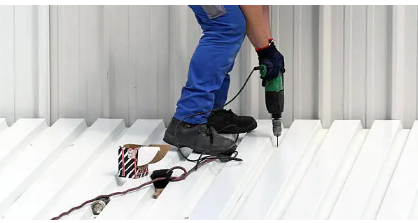
Even the strongest roofing material will underperform if installed incorrectly. The overall load-bearing capacity and storm resistance of COLORBOND roofing depend heavily on:
● Proper truss spacing and engineering compliance
● Correct screw type and fastening pattern
● Adequate roof pitch for water runoff
● Use of compatible insulation and sarking
Poor installation is the leading cause of wind damage, not material failure. When installed to Australian Standards, COLORBOND systems consistently outperform many alternative roofing options in both durability and longevity.
Maintenance and Inspection for Maximum Safety
To ensure long-term performance, homeowners should schedule periodic inspections, especially after major storms. Key maintenance tasks include:
● Checking for loose fasteners or lifted sheets
● Clearing debris from gutters and valleys
● Inspecting sealants around penetrations
● Looking for signs of coating wear or corrosion
Even though COLORBOND steel is designed for low maintenance, proactive checks ensure the roof continues to perform under structural load conditions for decades.
Final Thoughts
COLORBOND roofing offers a strong balance of lightweight construction and high structural resilience, making it a reliable choice for South Australian homes. While it is not designed to “hold weight” in the traditional sense, its engineered system distributes loads efficiently, enabling it to withstand storms, wind uplift, and moderate hail.
For homeowners evaluating Adelaide COLORBOND roofing, the key takeaway is that performance is less about the steel alone and more about the complete roofing system—design, installation, and maintenance all play critical roles in long-term durability and safety.